Every artifact
your team ships,
one container.
OmniRepo is a self-hosted registry that speaks OCI, RPM, APT, PyPI, Helm, Go, npm, Maven, Git, S3 & raw blobs natively, with built-in Trivy vulnerability scanning, project-scoped RBAC, and an air-gap invariant enforced in CI. Drop it on a host, point your build tools at it, done.
How OmniRepo slots into your stack.
One container sits between what your team builds and everything that consumes those artifacts, with no agents or sidecars to run alongside it.
Every artifact, scanned by Trivy. On the way in, and on the way out.
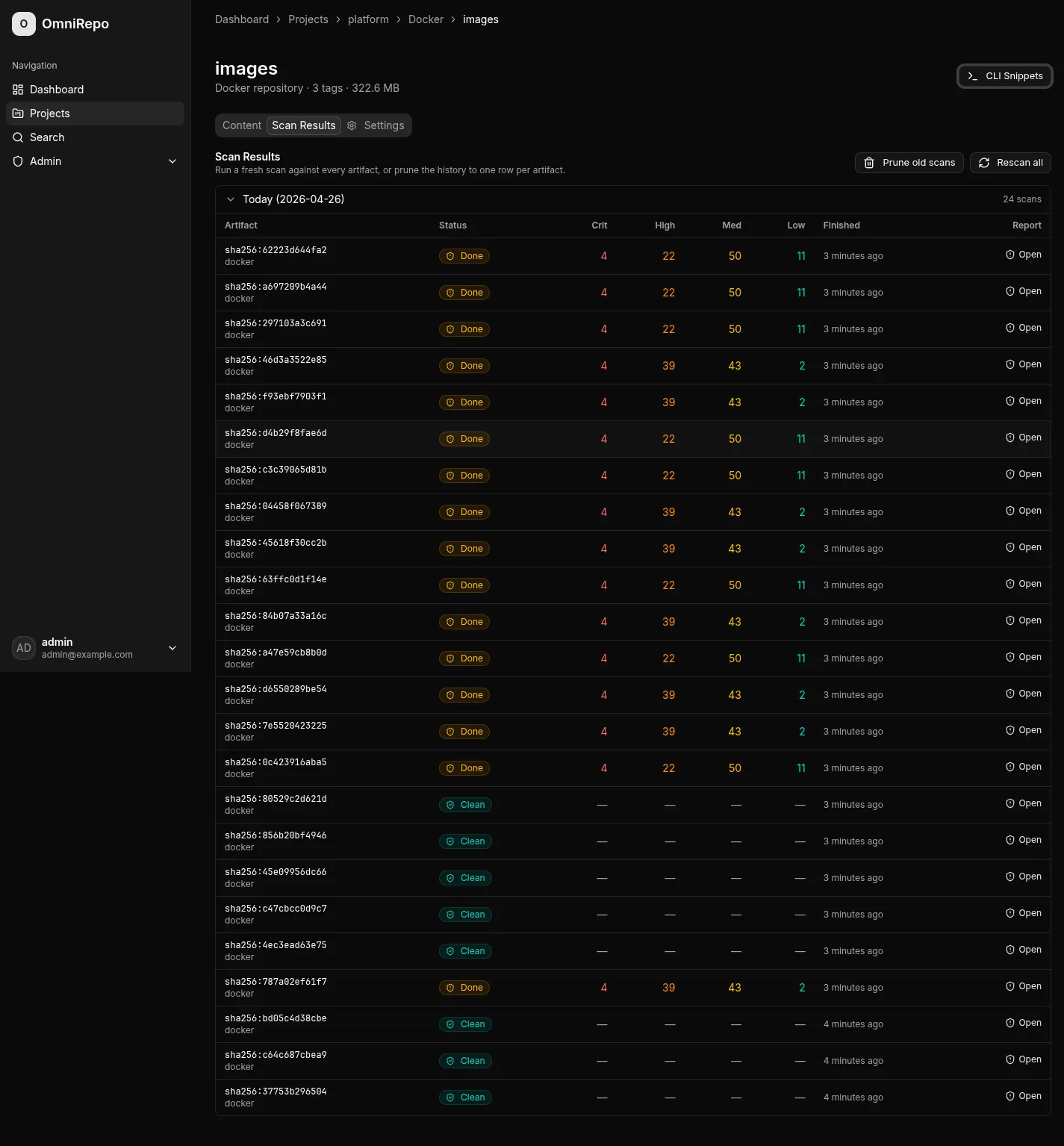
Trivy ships inside the container with an air-gap-baked vulnerability database. RPM cpio payloads and PyPI wheel transitive deps are unpacked before the scan, so Trivy sees real filesystem entries, not just metadata. Per-repo gates refuse pulls of artifacts whose latest scan found findings at or above your threshold.

Per-repo pull gates
Set block_on_severity to critical, high, medium or low. Pulls of unscanned-or-vulnerable artifacts return 403.
Deep scanning
RPM cpio payloads walked. PyPI wheel transitive deps resolved. OCI layers fully extracted. Trivy sees real filesystem trees, not artifact metadata.
Baked DB + tarball updates
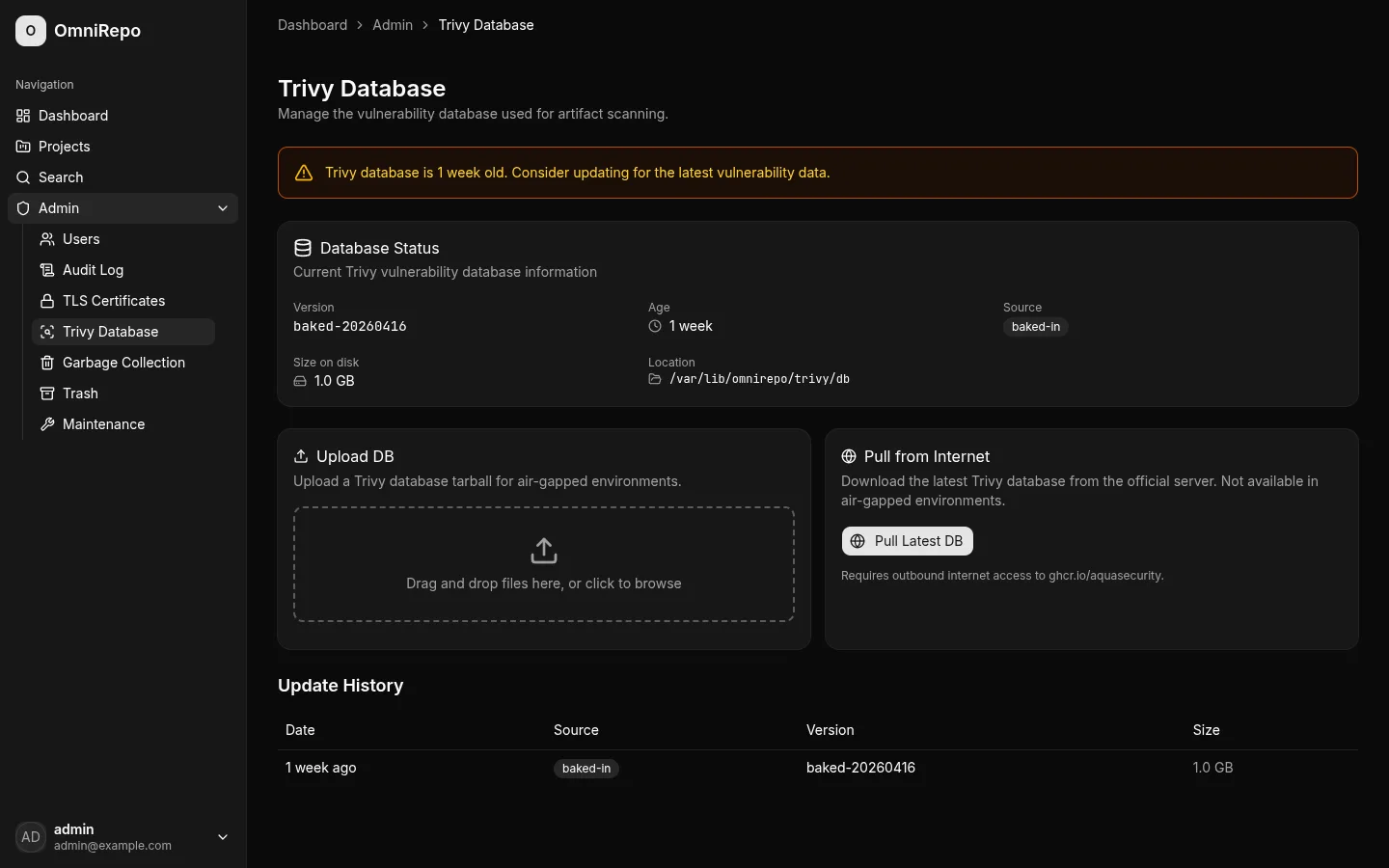
Ship with a vuln DB baked into the image. Refresh via Admin → Trivy DB: upload a tarball, or click to pull if the host is allowed outbound. Nothing phones home without you.
Scans don't block pushes
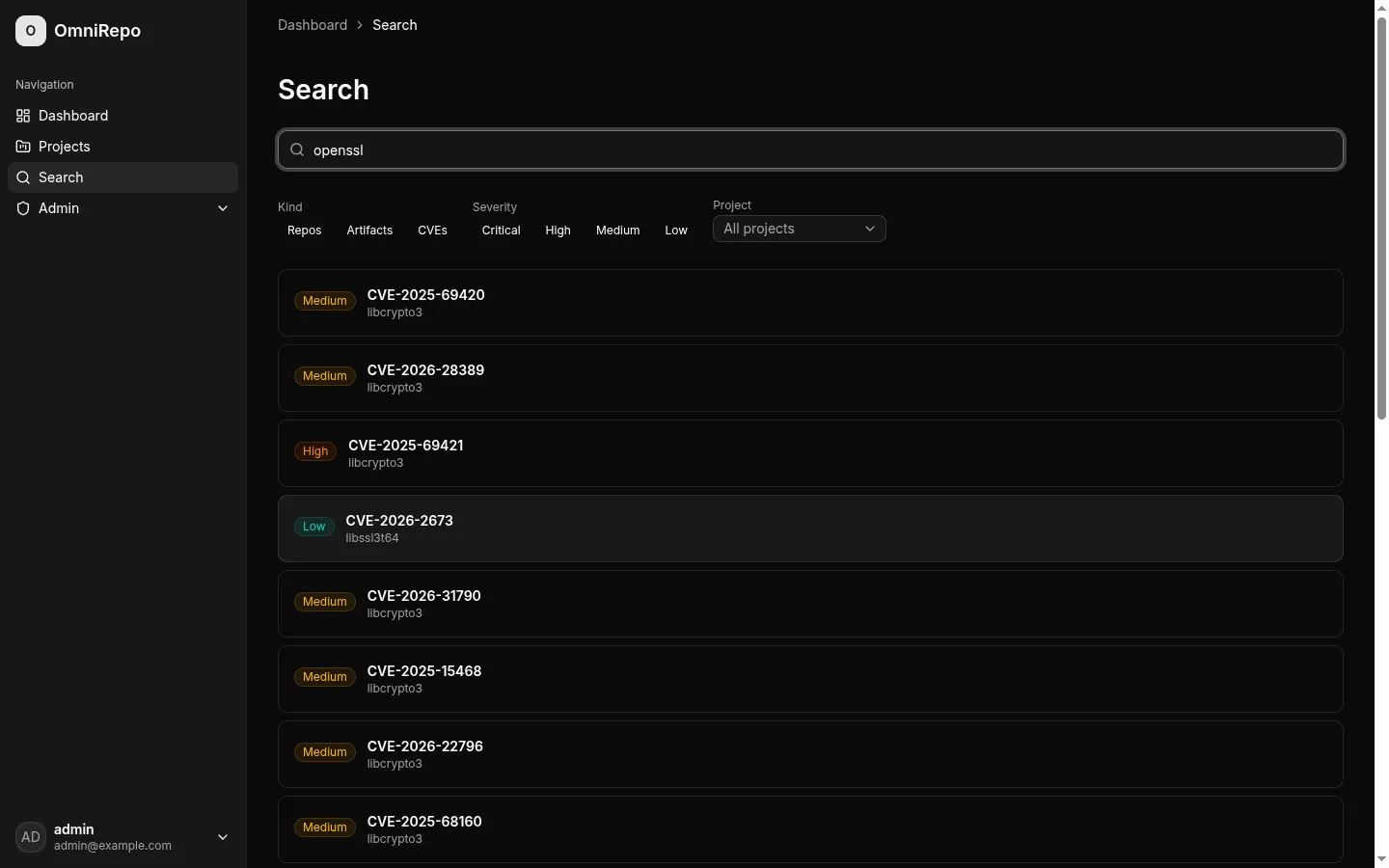
Scan jobs run in a worker pool. Results are indexed in SQLite FTS5 — searchable by CVE ID, artifact, or project from the sidebar.
A focused alternative to Artifactory and Nexus.
One Go binary. One HTTP/HTTPS port. One mounted volume. Multiplex every build tool in your shop through a registry that's auditable, scanned, and project-scoped by default.
One router, every protocol
Every handler mounts as an http.Handler on the same chi router. No sidecars, no reverse proxy, no adapter glue. Same auth, same audit log, same storage primitives.
Trivy-backed scanning
Embedded subprocess with an air-gap-baked DB. Per-repo gates refuse pulls above a severity threshold.
Unified content-addressed storage
A single SHA-256 blob tree underneath every protocol. No duplicates across repos; atomic renames; fsync'd parents.
Every action, auditable
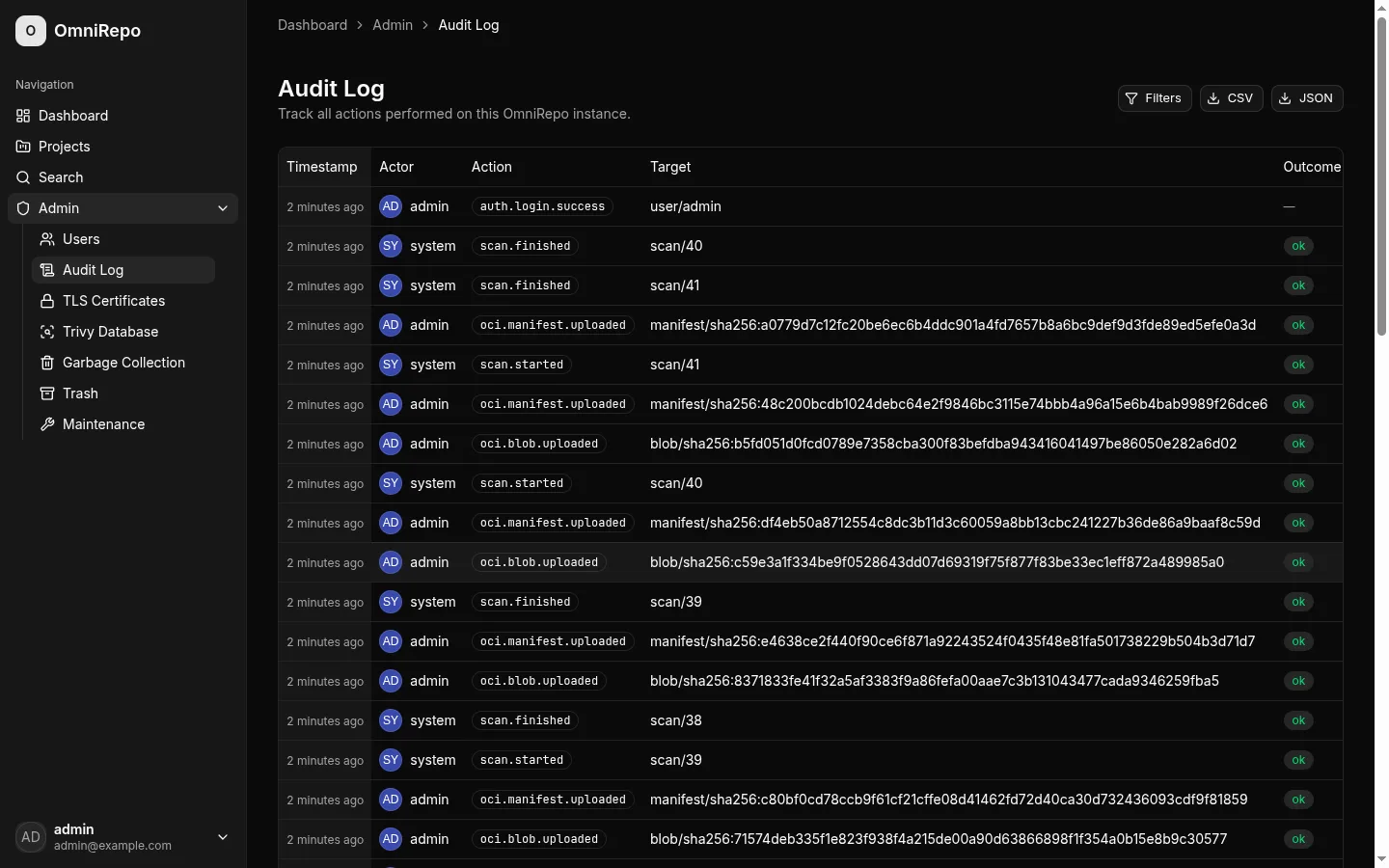
Auth decisions, uploads, admin changes — all logged to SQLite plus an NDJSON mirror you can tail.
API keys, not secrets
User-owned or project-owned. Prefix-indexed SHA-256. Shown exactly once.
Project-scoped by default
Flat user / project / member model. Every artifact lives under a project; non-members get a 403.
SQLite FTS5 across everything
Full-text search across repos, artifacts, CVEs and packages — one WAL-mode database, one binary. Filter by Kind (repos · artifacts · CVEs), Severity, or Project.
Upstream mirror repos
Mirror APT, RPM, PyPI, and Helm upstreams into OmniRepo's local cache, with per-protocol allowlist filters and optional stored upstream credentials, encrypted at rest. Native clients pull from your host, not the internet. Triggered on demand from the UI, or by your existing scheduler hitting /sync.
Drift purge with admin guard
When an upstream removes a package, OmniRepo's mirror reflects it: drifted artifacts move to the trash (7-day retention, restorable). If a sync would purge more than 50% of a repo, OmniRepo blocks it and shows an admin-confirm dialog so a broken upstream can't accidentally wipe your cache.
Clone images from any registry
Pull a specific tag or digest from Docker Hub, GHCR, or Quay into a local repo. Cherry-pick what you need, no full mirror required.
Go, npm & Maven registries new
A GOPROXY module proxy for go get, an npm registry with native npm publish and immutable versions, and a full Maven layout for mvn deploy / Gradle. Landed on main right after v1.0.1, shipping in the next tagged release.
Copy-paste client snippets
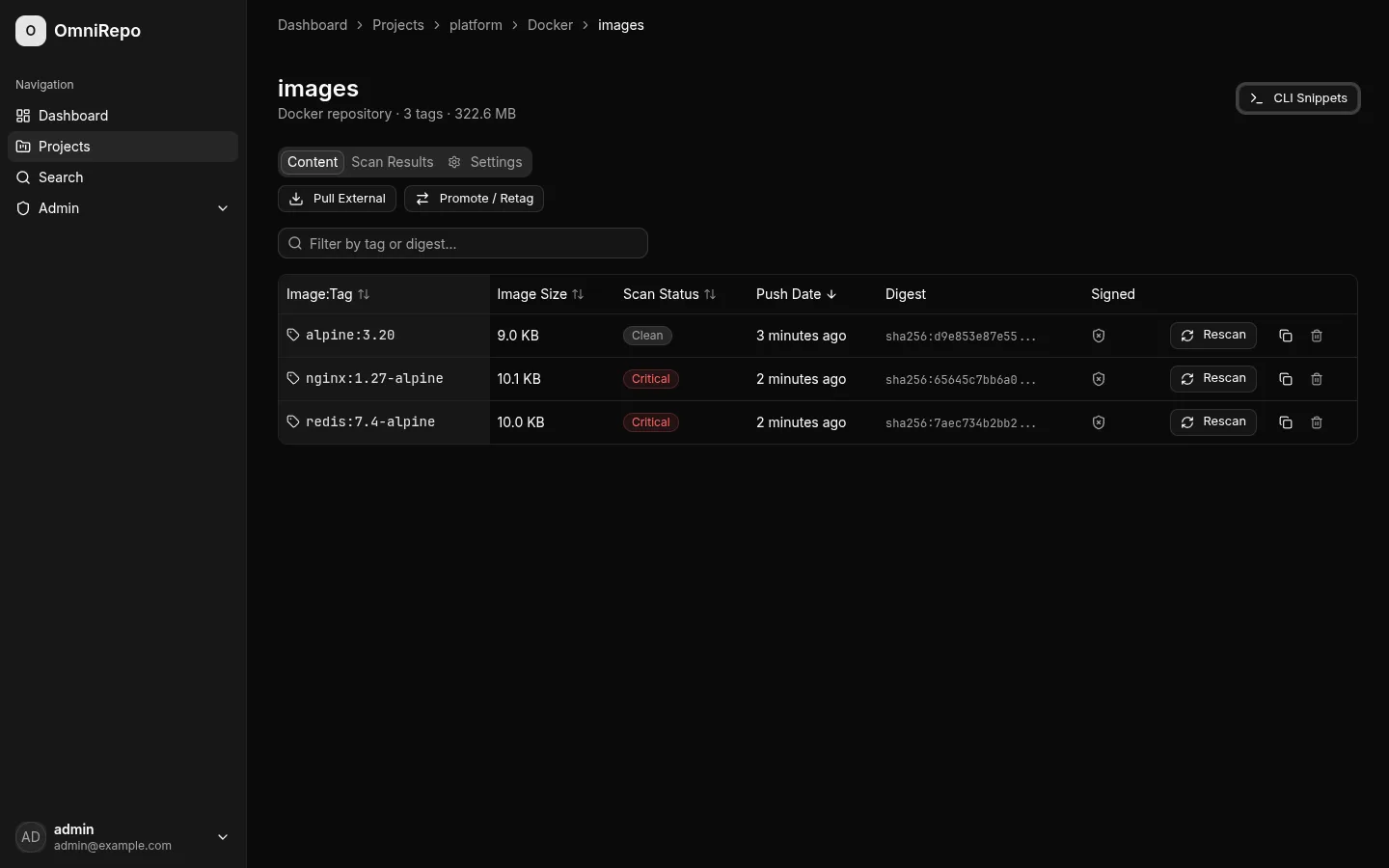
Every repo page shows ready-to-use commands pre-filled with your host, project, and tag: docker pull, pip install, helm repo add, apt source lists, GOPROXY exports, .npmrc config, and Maven pom.xml blocks.
Bootstrap from JSON
Seed users, projects, repos, and API keys from a single bootstrap.json on first boot. Fully automatable, no manual clicks.
"super_admin": { … },
"projects": […],
"repos": […],
"api_keys": […]
}
OpenAPI 3.1 + Swagger UI
Full REST API spec at /api/docs/. Explore endpoints, try requests, and generate client SDKs, all shipped inside the container.
A real dashboard.
Shipped inside the binary.
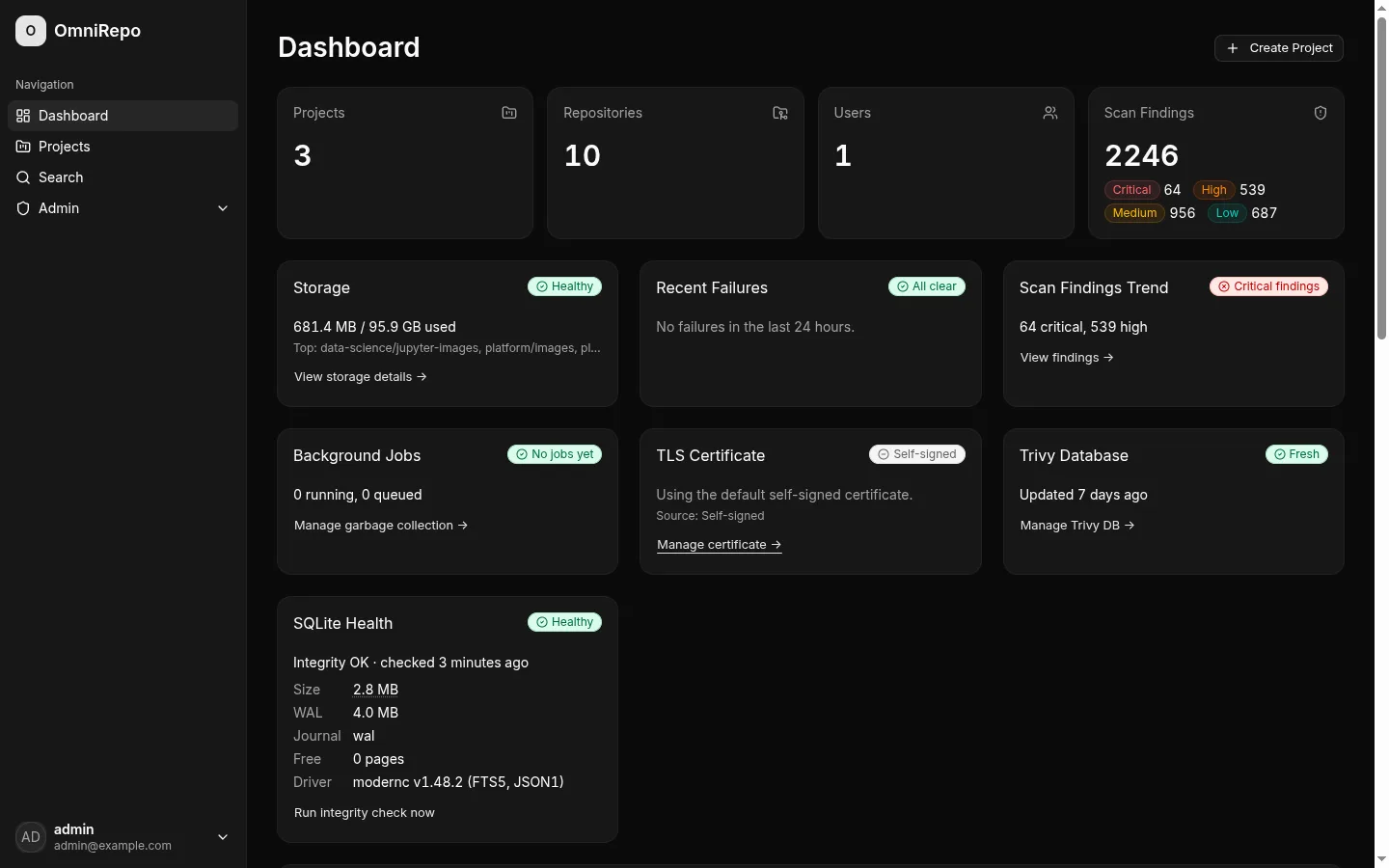
React 19 + shadcn/ui, embedded via go:embed. No extra container, no CDN, no third-party panel. Manage everything from one place: repos, scans, keys, S3 buckets, mirrors, and audit logs.
Air-gap by default.
Enforced in CI.
A hoard you don't share. No outbound HTTP from the binary without an explicit admin action, asserted with make test-airgap on every PR, where the binary boots in a sandboxed net namespace and must make zero outbound calls.

No CDN. No telemetry. No phone-home.
Fonts embedded. Icons tree-shaken into the bundle. Swagger UI copied at build time. Trivy shipped with a baked DB. The binary makes zero outbound HTTP calls of its own, asserted in CI.
Argon2id, not bcrypt.
m=64MiB, t=3, p=4 for passwords. API keys are prefix-indexed SHA-256. Docker JWTs are HS256 with a per-install 32-byte secret. Sessions are 12h sliding cookies.
Hot-reloadable TLS.
Upload a PEM pair through Admin → TLS. The live listener swaps without restarting the server. Old certs archived for rollback.
Five minutes to first push.
Pull the image, mount a volume, open the web UI. On first boot OmniRepo lays out the data root, applies migrations, and mints a self-signed TLS cert.
Run the container
One HTTP port, one HTTPS port, one mounted volume. That's the whole deployment.
Log in as super-admin
Seed from bootstrap.json or rotate the temp password on first login. Argon2id, session cookies, 12h sliding TTL.
Create a project & repo
Repos live under projects. Pick a type — docker, rpm, deb, pypi, helm, go, npm, maven, raw, git, s3 — and point your build tool at it.
Push. Scan. Pull.
Artifacts land in the CAS tree. Trivy scans in a background pool. Gates block severity thresholds on pull.
$ quick start · bash # 1. Run it docker run -d --name omnirepo \ -p 8080:8080 -p 8443:8443 \ -v /srv/omnirepo:/var/lib/omnirepo \ ghcr.io/vladoportos/omnirepo:latest # 2. Push an OCI image docker login https://host:8443 docker tag nginx:latest \ host:8443/platform/docker/images/nginx:latest docker push host:8443/platform/docker/images/nginx:latest ✓ sha256:f3e4… 2.1 MB / 2.1 MB pushed # 3. Publish a Python wheel twine upload --repository omnirepo dist/*.whl ✓ mypkg-1.2.0-py3-none-any.whl scan: 0 CVE # 4. Serve an APT repo (on the client) echo "deb https://host:8443/platform/deb/stable/ bookworm main" \ | sudo tee /etc/apt/sources.list.d/omnirepo.list sudo apt update && apt install myapp
Focused where Artifactory is exhaustive.
OmniRepo is built for small-to-mid teams and air-gapped corporate environments. If you need federation and HA clustering, grab a commercial tool. If you need one pane of glass on a single host, read on.
| OmniRepo v1.0.1 | Artifactory | Nexus Repository | Harbor | |
|---|---|---|---|---|
| Single static binary | ● pure-Go, scratch | ○ JVM + WAR | ○ JVM | ◐ Go, but split |
| OCI / Docker | ● native /v2 | ● native | ● native | ● native |
| RPM · APT · PyPI · Helm | ● all four, native | ● all four | ● all four | ○ OCI only |
| Go proxy · npm · Maven | ● native, on main | ● all three | ● all three | ○ |
| Git hosting | ● Smart HTTP | ○ | ○ | ○ |
| S3 API (SigV4) | ● gofakes3 + SigV4 | ◐ via gateway | ○ | ○ |
| Built-in vulnerability scan | ● Trivy, baked DB | ● Xray (paid) | ◐ IQ Server (paid) | ● Trivy |
| Air-gap invariant in CI | ● make test-airgap | ○ | ○ | ○ |
| License | ● Apache-2.0 | ◐ commercial | ◐ open core | ● Apache-2.0 |
Small surface. Hard numbers.

Fully open source, v1.0.1 shipped.
OmniRepo is open source under the Apache-2.0 license: the whole Go binary, web UI, and protocol handlers are on GitHub. The container image is free to self-host, forever. File a bug, request a protocol, or send a pull request. Issues and contributions are open.
Questions you're probably about to ask.
Short, honest answers. If something's missing, open an issue on GitHub.
How do I get OmniRepo?
v1.0.1 is the current release. Pull and run it: docker run -d -p 8080:8080 -p 8443:8443 -v /srv/omnirepo:/var/lib/omnirepo ghcr.io/vladoportos/omnirepo:latest — or pin ghcr.io/vladoportos/omnirepo:1.0.1 for reproducible deploys. Source code and releases are on GitHub; the install steps cover first-boot login.Does it support npm, Go modules, or Maven?
main right after v1.0.1 and ship in the next tagged release. You get an npm registry (packuments, tarballs, native npm publish, immutable versions), a GOPROXY module proxy (go get with GOPROXY pointed at OmniRepo), and a full Maven repository layout (mvn deploy / Gradle maven-publish with checksums and metadata). OCI/Docker, RPM, APT, PyPI, Helm, Git, S3, and raw are all in the current release.What does it cost?
Apache-2.0 license. There's no paid tier, no "open core" trap, and no license server phoning home.Is there a hosted / SaaS version?
docker run, your data never leaves your network.Does it support SSO / LDAP / OIDC?
v1.0, once the core protocol work is locked down and we can give enterprise auth the attention it deserves.What hardware do I need?
linux/amd64; arm64 / Raspberry Pi support is on the roadmap for a follow-up release.How do I back up the data?
Does it work in an air-gapped environment?
make test-airgap, which boots the binary in a sandboxed network namespace and fails if a single byte leaves. The only network egress that ever happens is when an admin clicks Update on the Trivy DB page, and even that is optional: you can drop a tarball onto disk instead.How does OmniRepo compare to Artifactory / Nexus / Harbor?
Where do I report bugs or suggest features?
Can I make a repo publicly readable without auth?
public_read: true on any repo. Anonymous GET and HEAD requests are allowed so native clients (pip, apt, helm, docker pull) can pull without credentials. Writes always require an authenticated user or API key. Useful for serving packages to CI runners that don't carry tokens, or for public open-source mirrors.How do I schedule mirror syncs? Is there a built-in scheduler?
POST /api/v1/projects/<p>/repos/<type>/<repo>/sync. We made this call early on: the right scheduler for your environment is the one you already have: crontab, systemd timers, Kubernetes CronJob, GitLab schedules, Jenkins, Argo, whatever. Adding one inside OmniRepo would mean re-implementing all of those badly. A one-line crontab entry beats a scheduler goroutine + a cron parser + next-run state + UI surface every time.
Ship artifacts. Not sidecars.
Deploy OmniRepo on any Linux host with one docker run. Bring your build tools, bring your air-gap policy, bring your audit requirements.